
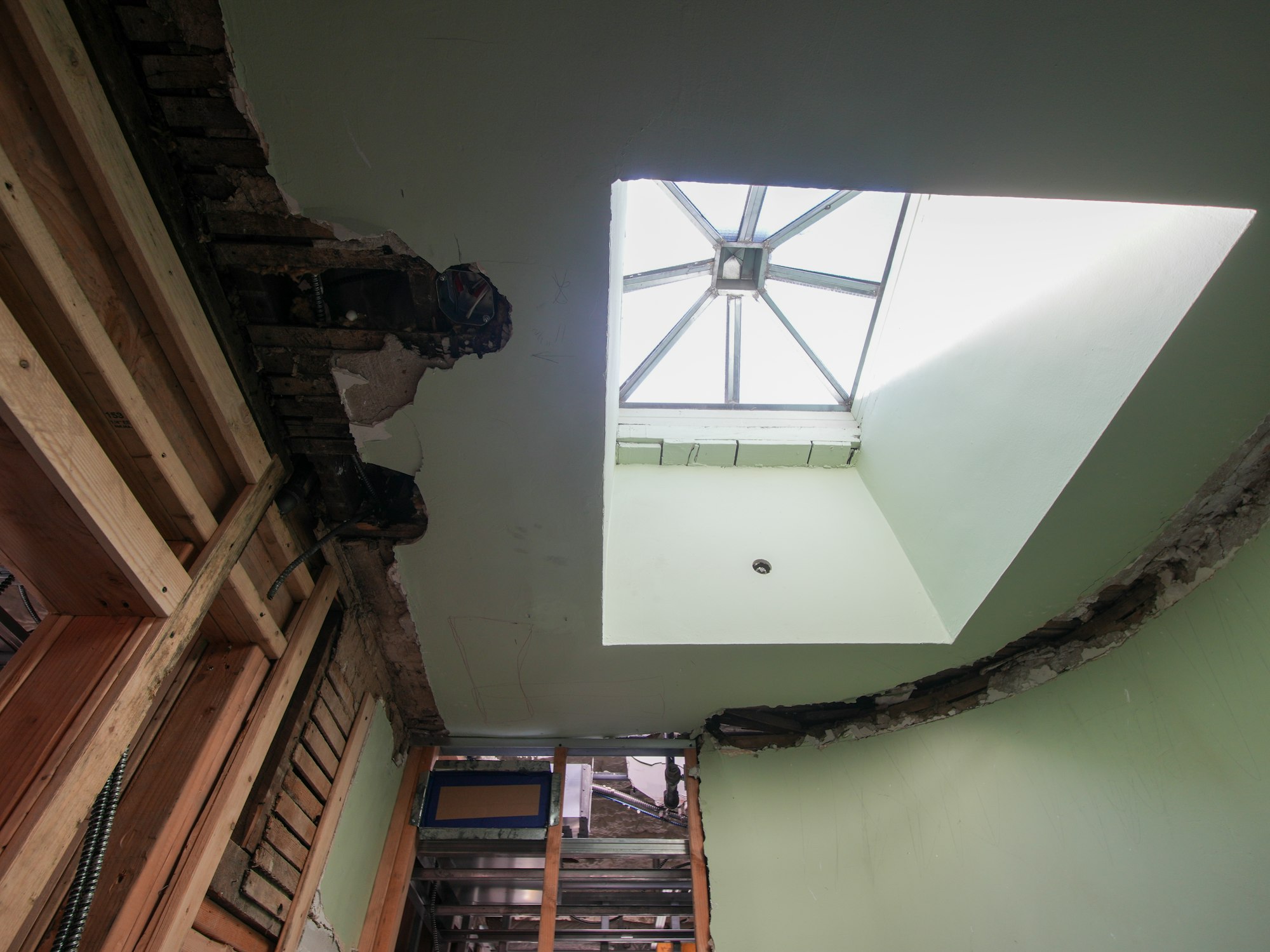
Most skylight leaks are not broken skylights. The water enters around the unit, and until you know which joint is failing, replacing the glass fixes nothing.
A skylight that drips after a storm is usually intact. In most leaks traced on roofs around Aledo and Willow Park, the glass and frame are sound and the water arrives from just outside the unit: the flashing kit, the curb it sits on, the cut edge of the deck, or the shingle course above it. A new skylight dropped into the same badly built opening leaks again on the next heavy rain.
A meaningful share of what homeowners report as a leaking skylight is also condensation, and the two look identical from the floor of a Parker County living room. What follows is why a skylight is the most leak-prone opening on a roof, how to tell a real leak from condensation, where the water enters, and what the repair-versus-replace decision looks like.
A Skylight Is a Hole in the Roof With a Lid on It
A skylight leaks more often than anything else on a roof because it interrupts the roof's shedding path in all four directions at once. Asphalt shingles do not waterproof a roof; they shed water downslope, course lapping over course, until it reaches the gutter. A skylight stops that handoff. Water from above has to split, travel around both sides and rejoin below, managed the whole way by sheet metal and overlap rather than by the shingles.
Compare it with the other penetrations on the same slope. A plumbing vent is a round hole a few inches across that one collar flashes, and when a pipe boot fails it fails at the rubber. A skylight is a rectangle two to four feet wide: an upslope head acting as a small dam, a downslope sill collecting whatever the sides deliver, two side runs needing step flashing woven course by course, and a deck cut open on four edges. That is why most roof leak repair calls involving a skylight turn into flashing work, not glass work.
Condensation and a Leak Look the Same From the Floor
Rule out condensation before anyone prices flashing. In Shedding some light on skylights for Professional Roofing, the National Roofing Contractors Association's magazine, James R. Kirby notes that "condensation also can occur on a skylight's interior face and may be misinterpreted as a leak," forming when the lens, frame or curb falls below the dew-point temperature. The most effective way to minimize it, he writes, is to adequately ventilate the space below.
The two have different signatures, readable from inside the house. Condensation shows up on cold, clear mornings when no rain has fallen, beads evenly across the pane and the metal frame, and is worst over a kitchen, bathroom or laundry. A real leak tracks rainfall, often an hour or more behind it, and concentrates: a stain at one corner of the drywall return, or a line down one edge of the shaft, with a hard edge that darkens with each storm.
A dry-morning wipe test settles most cases. Dry the glass and the frame from a step ladder indoors, then check again before sunrise. Moisture that returns with no rain in between is condensation.
Where the Water Actually Enters
When a skylight genuinely leaks, the entry point is nearly always one of five, and a written scope should name which one.
- The flashing kit. Head flashing at the top, sill flashing at the bottom, step flashing up both sides, each lapped into the shingle courses. One short lap, or continuous side flashing where step flashing belongs, and it leaks in wind-driven rain long before a calm shower touches it.
- The curb, the raised frame the unit sits on. Built low, or with settled deck around it, water stands against the curb instead of running past, and finds the seam beneath.
- The head, upslope of the unit. The hardest spot on the roof, because everything the slope collects above the skylight arrives here at once. On a long run above, a cricket does work head flashing cannot.
- The deck joint. The cut edge of the sheathing is raw wood under the underlayment. Wet repeatedly it goes soft, the fasteners holding the flashing lose their grip, and the leak widens on its own.
- The shingle course immediately above. A lifted or wind-creased shingle a course or two upslope dumps water under the head flashing rather than over it, common after hail along the western Tarrant County line and usually caught during storm and hail damage work.
Four of those five are roof assembly failures rather than skylight failures, and our walkthrough of what happens during a roof inspection covers how each one is read on the slope.
The Curb, the Flashing Height and the Sealant Question
Height keeps a skylight dry, not sealant. The U.S. Department of Energy's guidance on skylights states that "water leaks are a common problem with improperly installed skylights," and lists what prevents them: mounting the unit above the roof surface, installing a curb, which it defines as a raised, watertight lip that deflects water away from the skylight, adding flashing, and thoroughly sealing joints. It also calls it prudent to apply sheet waterproofing over the flanges and flashing.
Trade guidance is more specific about how high is high enough. Kirby's article recommends skylights be flashed in the same manner as chimneys, with curbs tall enough to allow an eight-inch vertical flashing height, four inches being called rational on a steep slope. That is the measurement a homeowner never sees and a roofer always should, and it is why shallow self-flashing units generate callbacks on slopes taking wind-driven rain off open pasture out here.
One warning. Do not go up and run a bead of sealant around a skylight yourself. Beyond the risk of a pitched roof, sealant over failed flashing lasts months and hides the evidence a diagnosis depends on. Failed flashing gets rebuilt, not caulked.
A Skylight and a Reroof Belong on the Same Schedule
Skylight flashing is woven into the shingle courses, so a reroof takes it apart whether anyone planned for that or not. Reusing eighteen-year-old step flashing and a tired curb under a brand new roof is a reliable way to buy a leak in year two, and a bad trade: that labor is already being spent during tear-off, while doing it later means opening a new roof back up.
The code side reinforces the point. The City of Fort Worth's residential re-roofing FAQ states that the requirements of Section R905 of the 2021 International Residential Code must be met on a replacement roof, and that while a shingle-only replacement on a one- or two-family dwelling needs no permit, a permit is required if any decking is replaced. A long-running skylight leak is what turns sound sheathing into decking that comes out.
If a roof replacement is already on the horizon, the skylight belongs in that estimate rather than a separate repair call, and our preparation checklist covers what else to settle with the crew before tear-off day.
Repair or Replace: What the Decision Looks Like
The decision turns on two questions: is the unit sound, and how much life is left in the roof around it. Repair is right when the glass seal is intact, the frame is not cracked, the deck is firm, and the leak traces to flashing, the curb or a shingle course above. On a roof with years left, that is a contained job.
Replacing the unit makes sense when the glass seal has failed, showing as permanent fogging between the panes that no cleaning touches, when an older acrylic dome has crazed, or when the frame has split. Timing counts too: if the roof is coming off anyway, swapping a tired unit while the opening is exposed costs far less than doing it later.
A third outcome sometimes fits an older home on acreage out toward Brock or Millsap. Where a skylight has leaked for years and the decking is soft, closing the opening and roofing over it can be cheaper and more durable than rebuilding, and it is worth pricing alongside the other two. Whichever way it goes, the work that follows is ordinary roof repair and decking replacement. If gutters overflow and drive water back under the courses above, gutters and downspouts are part of the same fix.
Start With the Diagnosis, Not the Skylight
The reason skylight leaks get expensive is rarely the skylight. It is the months spent treating a symptom, a bead of sealant each spring, a replacement unit set into the same shallow curb, while the deck underneath quietly goes soft. Everything useful follows from naming the entry point first: condensation or water, flashing or curb or head or shingle course, a contained repair or a line item that belongs in a reroof estimate. That answer comes from tracing the water inward from the stain, not from guessing at the glass. If a skylight is dripping on a house in Aledo, Annetta or Hudson Oaks, Roofing Aledo can trace it and show you where it starts on a roof leak repair visit.
Not Sure Whether It Is the Skylight or the Flashing?
An inspection traces the water back to the joint it is entering through, and ends with photographs of the entry point and a written grade for every slope.
Book a leak diagnosis